
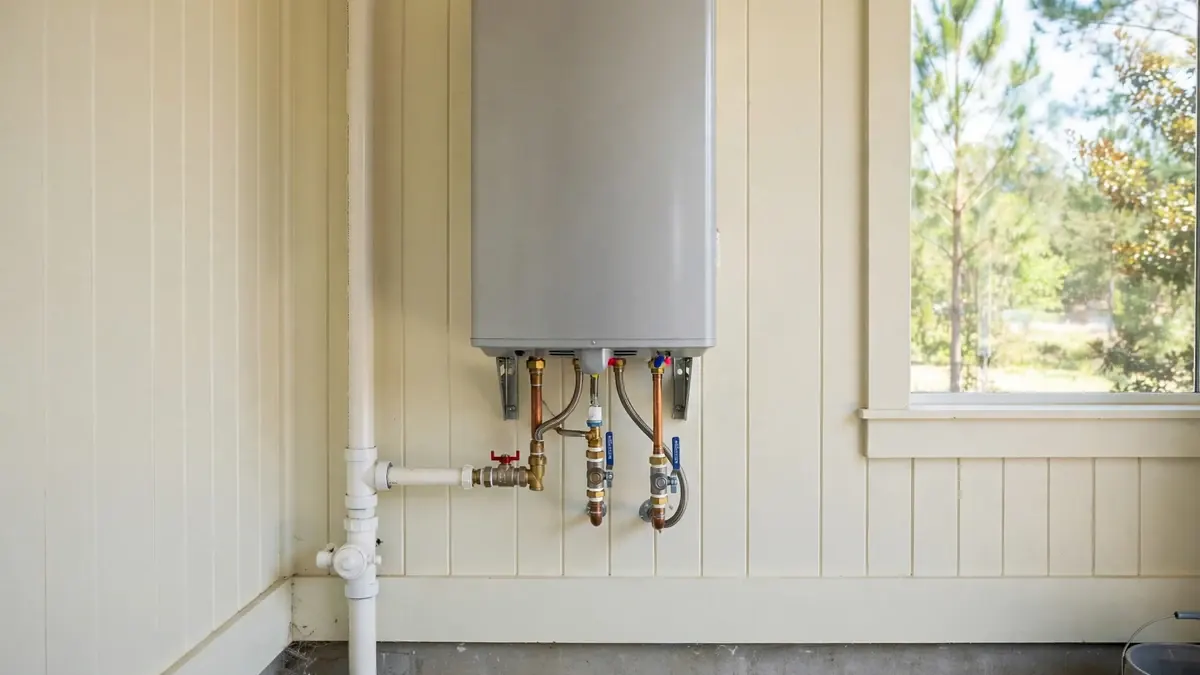
Why tankless quotes vary so much
Two homeowners on the same street can get very different tankless quotes. One house already has a large gas line and a vent path to the roof. The other has an undersized gas line, a heater buried in a closet and no condensate drain. The equipment is the same, and the job is not.
We do not publish dollar prices because the right number depends on your house. What we can do is show what goes into a price, so you know what to ask and what to expect on a written quote.
The five cost drivers
Unit capacity
Flow rate and temperature rise decide the model. A house with three bathrooms needs more capacity than a condo.
Gas or electric supply
A tankless gas unit can draw several times the gas of a tank heater. An old gas line may need upsizing, and electric units can need a heavy dedicated circuit.
Venting
Tankless units use special vent materials, and moving the vent route through walls or the roof adds labor.
Condensate and drains
High efficiency gas units produce acidic condensate that needs a drain or neutralizer.
Water quality extras
Isolation valves for flushing, and sometimes a scale filter, add scope but protect the unit.
Reading a tankless quote
| Line item | Why it matters | Red flag if missing |
|---|---|---|
| Unit model and capacity | Lets you compare apples to apples | Only a brand name |
| Gas line work | The biggest hidden cost | No mention of gas sizing |
| Venting plan | Affects code compliance | No vent route described |
| Condensate drain | Prevents backups and corrosion | Not mentioned for a condensing unit |
| Permit and inspection | Covers code compliance | Not discussed |
| Flush valves | Allows future descaling | Not offered |
Tankless versus tank: the honest comparison
A tankless unit has no standby heat loss and can last longer when maintained, and it frees wall or closet space. A tank unit costs less to buy and install, and it is simpler to repair. A household that uses little hot water may never recover the extra upfront cost, and a large household with heavy use may notice the savings and the endless hot water.
If your current tank has failed, compare water heater installation options for both types before deciding. We give a clear price for each, so you decide with real numbers in hand.
Hard water and why it affects tankless cost over time
Hardness is the cost nobody puts on the first quote. The Coachella Valley Water District's 2025 water quality report lists hardness for its Cove Communities area between 8.4 and 310 mg/L, with an average of 120 mg/L. That spread is wide, and your address may sit anywhere inside it or in a different service area entirely.
Scale narrows the heat exchanger and triggers error codes, so a flush every year is part of owning a tankless heater here. Ask your utility for the report that matches your address, or test your tap. Then ask the installer to include isolation valves so that flush is a short visit and not a plumbing project. Plumbing work in California is checked against the California Plumbing Code, which is based on the Uniform Plumbing Code (UPC). It also governs venting and gas connections, which is why gas sizing and the vent plan belong on the quote.
Source type: Coachella Valley Water District 2025 water quality report.
Questions to ask every installer
Ask who checks gas pipe sizing and how. Ask where the vent will run and what it will pass through. Ask what the warranty covers on parts and labor and what maintenance it requires. Ask whether the quote includes the permit and who schedules the inspection.
A reliable installer answers these plainly and puts them in writing. If the answer is vague, treat the quote as incomplete and ask for a revised version before comparing it to any other.
Mistakes buyers make with tankless quotes
The first is shopping on unit price alone. A cheap unit installed on an undersized gas line performs badly and fails early. The second is skipping the water test. A heater that ignores your hardness number will scale up faster than the brochure suggests. The third is buying online and hiring an installer afterward without checking that the model suits your venting and gas.
A fourth mistake is assuming a tankless heater delivers unlimited hot water to every tap at once. Each model has a maximum flow. If two showers and a dishwasher run together, a unit sized for one bathroom will struggle. Tell the installer how your household actually uses hot water so the capacity matches.
What happens on installation day
The crew shuts off water and gas, drains and removes the old heater, and mounts the new unit on the wall. They run the gas line, vent and water connections, add isolation valves, connect the condensate drain and fill the system. Then they test for leaks, check combustion and program the temperature.
A standard swap is often a one-day job, but conversions that move the heater, upsize gas or run new venting can take longer. Ask the installer for a schedule and a plan for hot water during the work. Plan around showers and laundry so the day goes smoothly.
Common questions
It can be, but the higher install cost may take many years to recover when usage is low. Compare against a new tank unit.
Yes. Incoming water here is warm in summer, which reduces the heating the unit must do, though scale remains the main concern.
Follow the manufacturer's schedule and shorten it if your water is hard. Annual flushing is common.
Often yes, if gas sizing, venting and clearances work. A site visit confirms it.
The Building Division handles plumbing permits and is open Monday through Thursday. Check requirements for your project with the division.